Episode OneTwo Ravens on an Orange Tree
Prologue
Two Ravens on an Orange Tree
Two ravens sat on an orange tree branch. They were watching a boy dig a hole. The boy’s head disappeared down into the hole and out came a shovel full of dirt.
“Is he the one?” the first raven said.
“Maybe,” said the second one.
The boy's head reappeared. He whistled a tune as he shoveled.
“What is it about this one and not any of the others?” the first raven asked.
“I don’t know,” the second one replied. “Maybe nothing.”
“It must be something, or we wouldn’t be here, would we?” the first raven flapped its wings impatiently.
“He’s lonely,” said the second. “He’s the only one left in this village.”
The first raven turned to face the second one. “How long have you been with us, Carmen?”
“A month next week,” the second replied.
“Is this your first visit to The Field?”
“Yes.”
“I see.”
“And you’ve done your research?”
“As much as I’m allowed. I’m only a one-stripe.”
“Well…” the first raven stiffened with authority. “Being lonely doesn't make him special,” he croaked, edging toward the branch and readying to fly away.
“No,” the second one said quickly. “It doesn’t.” She turned. “But listen.”
They listened.
A warm, gentle breeze came up through the tidy rows of orchard and carried the boy’s sweet, sad tune up and over the treetops, into the pale blue sky above. It spread out over the hillside and down into the lowlands.
After a moment, the first raven muttered in thought: “Hmm…”
He listened again.
“Well, I suppose,” he squawked, “when the next cycle begins, I will give them his name. And then we will see.”
And then he spread his black wings and flew off toward the winding river which flowed slowly in the direction of the great cork oak forest.
The boy stopped whistling. He turned his head at the sound of the flapping wings. He shielded his eyes from the sun as he looked to the sky. Then he threw the shovel out of the hole and sat on the edge. He wiped his forehead with a dirt-caked kerchief, dipped a hand into a bucket of water, and drank from it. Then he lay on his back and stared at the clouds and began to whistle once again.
The second raven crept slowly out to the end of the branch. She listened for a while longer as the boy whistled. And then, she too flew off in the direction of the river. And as she followed the winding waterway in the direction of the old cork oak forest, Carmen Ophelia Mossbeard-Xana thought to herself:
“He may be the one.”
Chapter One
The House in the Orange Grove
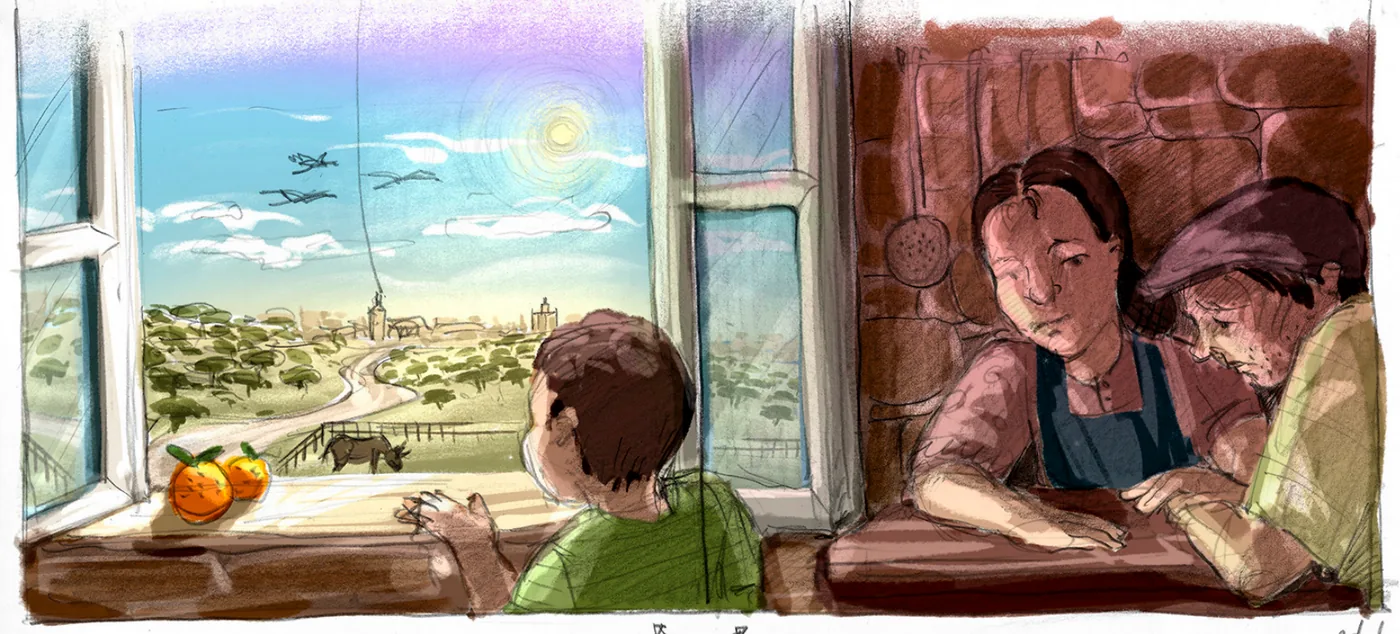
The boy’s name was Hugo, and he lived with his father and mother in an old stone house in the middle of an orange tree grove. In that part of Spain, there had been no rain for more than two years, and most of the other families had moved away to the north.
Hugo was the only child left in the village.
Hugo Soto stood barefoot on the cold tiles of the kitchen floor and peered over the counter as his mother sliced an orange. “I want to go north, too,” he said. “To be with my friends.”
Yago and Pedro were probably playing a game of chase in the town square where they lived. He missed their games.
Hugo’s mother put the knife down on the wooden countertop. She wiped her hands on her apron and looked at her son.
“How can we go?” she asked him. She raised her eyebrows which bunched the worry lines on her forehead. “We have debts. And your father’s not well.” She sighed. “And besides, sour oranges grow everywhere and ours are the only sweet orange trees from here to Cádiz. We must tend to them until your father gets well and the rains come back.”
She pushed aside a strand of gray hair which had strayed from its bun and looked out the window above the stone sink, saying nothing more.
Hugo knew his mother was right. The river was low and the land was dry. As the orange orchard faded, so did his father. Hugo’s father had grown ill and now sat all day in a rocking chair by the window in the stucco-walled great room, gazing out at the rows of trees in the orange grove. He no longer spoke.
Hugo still tried to engage him. “Papa, the trees look good, ya? They’re starting to grow better.”
Still, no answer, no matter what he tried.
With no one else to help, Hugo began to dig wells and canals with his mother to move what water they could to the grove. He spent the mornings in a hole with a shovel, digging a well by the edge of the woods.
In the afternoons, when it was too hot to dig, he helped his mother make orange marmalade to sell in Seville. As he stood in the kitchen and stirred the boiling pot of sweet oranges, he’d dream of the days when the trees were full of sweet citrus and children filled the village streets.
In the old days, after a full day, still soaked in sweat and caked in dirt, he would rest in the shade of the village square and listen to the men who played guitars by the old stone fountain.
The sound of the guitars was sometimes quick as the hooves of a galloping horse. Then slow as honey and sweet as an orange.
The music was called flamenco. The rapid steps of the dancers’ heels with the rhythms of the guitar put him in a trance.
To Hugo, it was like the sound of rain on cobblestones warmed by the sun. Plip, plop. And like the rumble of the river as it slid out to sea. Rum bum bum. And also the wind in the trees of the old cork oak forest, where he’d often walked with his father, in those old summers when his father could still walk.
Shhh, shhh, tap-tap, clap-clack . . .
But today, the village square was empty. No one played guitar. No one sang. The old stone fountain at the center of the square was dry. Only the innkeeper’s wife hummed softly to herself as she stood on the cobbled stones outside the inn and beat at a dusty rug with a wicker slapper.
“Where did everyone go?” Hugo asked the innkeeper’s wife.
“North.” She shrugged and slapped the rug and a little cloud of dust hung in the air. Her weathered face both smiled and frowned. “That’s where they all go.” She slapped the rug again.
Hugo walked home. Out of the village, across the lavender field, up the slope of the hill, and through the orange grove to the barn. He took up the shovel and went back to digging the well.
He could still hear the trill of the chimes in the trees in the grove. Trini trini tra la la. And the sound of his heart when he scooped at the dirt. Thump. Thump, thump . . . And when he rested on his back in the shade. Dun, dun.
Plip plop, clap clap, rum bum, trini tra la la, thump thump, dun dun.
These melodies filled an empty place inside him. Although there were no longer musicians in town, he heard these melodies everywhere he went. Where did they come from?
That night, as he lay on the straw mattress of his bed, the song of a sandgrouse came through the window of his room. The song echoed between the thick clay and stone walls. Hugo knew that song well. He remembered the sunlight filtering through the canopy of the old cork oak forest, and how his father could call out the names of the birds just by the sounds they made.
The names were enchanting and exotic—black-bellied sandgrouse, short-toed larks. Rock sparrows and red-necked nightjars. Blue rock thrush, spectacled warblers. Each letter and word jumbled around in his mouth, lighting up his senses.
The forest is enchanted, his father would tell him, and with a twinkle in his eye, he would point out more exotic creatures like monarch butterflies, painted frogs, marbled newts, honey buzzards, and griffon vultures… As he spoke each name, it was almost like reciting a spell.
While Hugo daydreamed of walking the forest and seeing those strange creatures with his father once again, he pulled open the drawer of the small table beside his bed. Inside was tucked a leather-bound journal and a set of colored pencils his father had given him for his seventh birthday. It replaced the slate board on which he drew trees and sky and clouds and houses and suns with nubs of chalk.
He had filled its pages with colorful stick-figures of red-necked nightjars and marbled newts and honey buzzards and painted frogs.
One night, he showed his father a page he’d filled with butterflies. He saw pride in his father’s eyes.
“You know Cervantes?” his father asked. “The great writer? He lived not far from here, for a time, when he was a boy. And Murillo, the famous painter, was born just up the road. And the girl who played piano for Queen Isabella at the age of six…”
“All of them came from here?”
“Yes, my son. There is something about this place, this little corner of the world, that inspires great artists. One day I think you’ll be one, too. There’s nothing you can’t do with a little imagination and a lot of hard work.”
But now, as Hugo flipped through those pages, he wasn’t sure that was true. His eyes grew tired. He put the journal back in the drawer and blew out the candle. The smoke rose in a wisp, up through the shadows and over the imagined creatures that danced on the walls and into the roofbeams.
He thought of all the things he might one day be— with a little imagination and a lot of hard work. An artist, maybe . . . or the captain of a merchant ship, sailing to the other side of the world . . .
Above all, he wanted to make music.
He enjoyed these thoughts. Yet, in his heart, he knew the answer. He would stay there forever, in his little riverside village, taking care of his father and tending to the orange grove. No amount of imagination or hard work would change that.
In the cool shadows of the bedroom wall, figures danced to a silent rhythm. Red-necked nightjars and short-toed larks. Honey buzzards and marbled newts. And others - stranger creatures Hugo couldn’t yet name.
He closed his eyes.
The songbird trilled. He heard music in his dreams.
Shhh, shhh, tap-tap, clap-clack…
Chapter Two
The Marmalade Jar
That night, Hugo dreamed of playing the guitar.
In his dream, he sat in a chair on a stage in a square in the center of Seville but he wasn’t nervous. An audience so vast he couldn’t see their faces cheered him and called his name and threw flowers at his feet as he tuned his guitar.
From beneath a broad-brimmed hat, the Mayor called Hugo the greatest flamenco guitarist in all of Andalusia. Indeed, the greatest flamenco guitarist who had ever lived.
Hugo Soto was now famous, the mayor said. The most famous musician of all! Even the singer called The Desert Lark was Hugo’s greatest admirer. Hugo shrugged and pretended to be embarrassed.
The mayor left the stage and then suddenly Hugo’s fingers flew up and down the neck of the guitar and flamenco music poured out from him. As he played, one by one, his friends stepped out of the audience and onto the stage. Yago stood beside him and clapped while Pedro danced.
He could see their faces. He was so happy to see them.
Among them, however, was a girl he didn’t know. He couldn’t see her face. She was trying to talk to him, but he couldn’t understand her. It was as if she was speaking a foreign language.
Clouds gathered in the sky as if they were summoned by the music. A little rain fell and the audience began to scatter and drift away. The faceless girl kept talking as Hugo’s friends stayed with him and laughed and danced and clapped as the raindrops splashed on the stage.
A man appeared on the stage. He stood in a shadow.
His eyes glowed orange.
The girl screamed.
Nonsense words.
“Humdrumbl!”
Hugo jolted awake. His heart raced. It was only a dream. Strange and familiar. He closed his eyes and pulled his blanket tight. He wanted to finish it. To find his friends. To play guitar. To help the girl. But morning came and sunlight slanted in through his window. And finally, he threw off the blanket and rose from his bed.
“When I grow up, I will be a great guitarist and make my own music,” he told his mother over breakfast. “And if it takes a hundred years, I’ll save the money to buy the finest flamenco guitar in all of Spain.”
A soft smile spread across her face. “Where do you get your love of music?” his mother asked.
“Where does anything come from?” he replied. “It just is.”
His mother smiled. Knowing Hugo’s loneliness, she tousled his hair and said, “Son, no digging wells for you today.” She looked to the window and squinted. “Go pick the ripest oranges, I can see there are a few that are ready. Fill a cart and sell them in Seville. And then take the money and buy yourself a fine guitar.”
“Do you mean it?”
His mother went to the cupboard and took down the marmalade jar where she kept the coins for the land payment. She counted out what was owed and set it to one side, and what little remained she folded into his hand.
“The orange money is yours today,” she said. “The rest we will manage.”
“But the debts—”
“Are mine to worry about,” she said. “You deserve it.” She put her hands on his shoulders and kissed his forehead.
The sandgrouse sang in the grove. Hugo’s father turned to the window. The corners of his mouth lifted just a little under his cheeks, and Hugo knew he was trying to smile. But there was no smile in his eyes.
Perhaps, soon, he could play a song for his father. Maybe that would pull him from his trance.
Chapter Three
The Street of Carpenters
Hugo’s father had taught him the proper way to pick oranges so as not to harm the fruit or the tree.
Look for the heavier ones, on the outer branches, those are the first to ripen. You must use two hands. Raise your arms to eye-level and keep the branch steady. With your left hand, hold the branch and pinch the stem. With your right, twist the fruit gently, back and forth, while pulling upwards. Use a delicate but still firm grip.
Hugo whistled as he picked all the best oranges from the trees in the grove and piled them high in a three-wheeled cart. The tune he whistled was somehow familiar, but he wasn’t sure where he’d heard it, or if he’d heard it before it all.
He whistled it more as he held the branches down and pulled the oranges up, twisting, twisting, gently back and forth. He whistled along to the rustle of leaves, the creak of the branch, and the snap of the stem as each orange came free.
Rustle, creak, snap. Rustle, creak, snap.
When the cart was full, Hugo pushed it from the village, across the lavender field, and down to the river, where he followed the riverside footpath, bumping along, whistling and humming, all the way to Seville.
Ravens watched from the treetop as he made his way.
He crossed the footbridge over the river, heading to the heart of the city. The buildings grew taller. Horse-pulled wagons crowded the path. As the dirt road turned to cobblestone, the three-wheeled cart began to bounce and hop. Hugo could hear each beat of the wooden wheels against the hot stone.
He saw the belltower of the great cathedral that looked out over the white-walled city, and heard its bells begin to ring in the noon hour.
Clang, clang, clang . . .
Across the footbridge, people filled the streets, some already dressed for the spring festival, and Hugo hoped their stomachs were empty and their pockets were full.
He followed the sign to the market square, where he found a place among the butchers, fishmongers, and trinket peddlers. They shouted out, smooth and fast, about the freshness of their fish and meat, the finery of their trinkets.
Hugo parroted them.
“These are the sweetest oranges you’ll find! In fact, these are the only sweet oranges you’ll find in Seville!
He yelled to everyone who passed. A few only looked at him but finally a man stopped and tilted his head. “I’ll take one to try.”
The man was pleased and held it up to announce, “He’s right! It’s the sweetest orange I’ve ever had!”
Others stopped to buy oranges after that, and by the end of the day, his cart was emptied, and his pockets were filled with coins.
Hugo counted his money and smiled. From a woman at a pastry stand, he bought a plate of prawns wrapped in slices of ham, some octopus, and churros with a warm mug of chocolate sauce.
“Do you know where I might buy a guitar?”
“Well, go to The Street of Carpenters, an alley near the great cathedral in the city center. Look for the workshop of a guitar-maker named Antonio Marin.” She winked. “He has the best guitars in Seville.”
Hugo smiled wide and thanked her. In no hurry, he wandered through the narrow, winding streets, pushing the three-wheeled cart and chewing his prawns and octopus and cakes. He passed well-dressed men and women who sat idly at tables outside cafes, drinking coffee. He stopped to peer in shop windows— a hat shop, a fabric emporium, a store that sold clocks.
Soon enough he reached The Street of Carpenters, where he was pointed to an alley not far away by the shopkeeper of the curio store. There at the end of the alley, he found a hand-painted sign above a red door.
The sign was old and weathered but the cutout of a small guitar and the name of Antonio Marin remained clear.
A cat sat in the low doorway, a plump Siamese with drooping whiskers and sharp, blue-gray eyes. The cat greeted him with a mew, interrupted by a cough, a gag, another long, retching gag, and then the expulsion of a good-sized hairball.
Poor fellow, Hugo thought, as he gently ran his hand down the cat’s back while pushing his cart against the door. As he opened the door, the cat scampered inside the store, leaving a trail of paw prints in the thick sawdust that covered the floor.
Hugo followed.
The workshop was thick with the smell of cut wood. Spruce and cypress and rosewood. Sunlight slanted in from an open window onto a tall, thin man who stood hunched over a workbench, pulling slowly at a handsaw. Saw dust hung in the air around him. The cat crossed between the man’s long legs, circled back to rub against an ankle, coughed again, and pulled at a piece of guitar string which hung from the man’s pocket.
“Ah, Gobbolino, there you are. Where have you been?” the man said, leaning over to pat the cat’s head.
Hugo stood inside the doorway admiring the rows of stringed instruments that hung from all four walls. Smooth and pear-shaped, slim necks, some blonde, some dark, some a bit of both. They were arranged in tidy rows by size, smallest to largest. No two were the same.
“Are you Antonio Marin? The guitar-maker?” Hugo finally asked.
The man did not respond. Instead, he spoke to the cat. “Have you seen my chisel, Gobbolino?” he asked. “I can’t find it anywhere.”
Hugo coughed. “Hello?” he said.
The cat turned its head toward Hugo, and the man turned around.
He raised an eyebrow. He rested the saw atop a set of paper diagrams, on which designs for a guitar were drawn.
“Oh,“ the man said, wincing and tilting his head in Hugo’s direction. “Can I help you?”
Hugo pulled a handful of coins from his pocket and put them down on a table by the door. He cleared his throat and spoke a little louder, “I’d like to buy your finest guitar, please.”
“What?” said the guitar-maker, cupping his hand to his ear. “Come closer, young man. I need to see your face.”
Hugo repeated, in an even louder voice, that he’d like to buy a fine guitar. He pointed to the coins on the table.
Antonio Marin gave a sympathetic little laugh. “That’s not enough money to buy a fine guitar,” he told Hugo with a slight chuckle. “That’s not enough money to buy any guitar.”
Hugo pulled the remaining coins from his other pocket and piled them on the table too.
Antonio Marin shook his head.
“How much money do I need?” Hugo asked.
The guitar-maker scratched his cheek and considered the two little piles of coins. “Ten times that much, at least,” he said.
Hugo’s heart sank. He looked at the guitars on the wall, which hung in silence. “There must be one guitar I can afford?” he pleaded.
“What?” Antonio cupped his ear.
Hugo turned to Antonio and repeated what he had said, but much louder, exaggerating the movements of his lips.
Something changed in the guitar-maker’s expression. He stared at Hugo for a moment. “You look familiar,” he said. He scratched his cheek again. His look was friendly, but quizzical.
Hugo shrugged.
“I feel as if I’ve seen you before.”
Hugo shrugged again.
The guitar-maker shrugged. “Hmm . . .” He thought for a moment. “Well, something is telling me to help you,” he said. “A little voice in my head is saying, Antonio, help this poor boy. He might be a great flamenco guitarist one day!”
Antonio let out a belly laugh.
Hugo took a step back, thinking maybe he should run out the door.
Antonio struck his best flamenco pose and laughed again. “Besides, business is slow,” he said. “Very slow. Everyone is moving away to the North. But Gobbolino has returned. Where do cats go all day? It’s a mystery. Anyway, let me see….” He continued muttering to himself as he went to the back of the store and disappeared into a storage closet.
While he waited, Hugo looked about the workshop. A wooden handle poked out from beneath the paper diagrams on the workbench. Hugo lifted the sheets — a chisel. And there, in the sawdust of Gobbolino’s corner, half-buried like a coin in sand, lay a little brass hammer. He set them side by side on the workbench where they could be found.
“Gobbolino…” Hugo heard him say. “Gobbolino, have you seen my little hammer? It’s gone missing too…maybe it moved to the North…”
Hugo heard some banging, and then the plucking of strings, one by one, and then a few quick strums. Bang, bang, plink, plink, plink, strum, strum.
Antonio Marin returned with a battered old guitar in his hand. He stopped. He looked at the chisel and the little hammer lying together on the workbench, and then at the boy, for a long moment.
“Well,” he said. “Good eyes and quick hands. That’s half of flamenco already.” He held the guitar out by the neck for Hugo to see.
It was beaten and weathered. Cracked and dented. Scratched and chipped. It looked like it had been dragged through the streets by a team of horses.
“It might be a bit out of tune,” Antonio Marin said. “I don’t hear very well anymore.”
Reluctantly, Hugo took the guitar. With a sigh, he strummed it.
Twang.
The strings felt tight and the sound was flat. They rasped and buzzed sadly before quickly giving way to silence.
Seeing the disappointment in Hugo’s eyes, Antonio reached into his pocket and handed Hugo a few extra strings of sheep gut and silk wrapped in thin wires of silver. “You’ll need plenty of these,” he said.
Well, this was a start. And better than no guitar at all.
Hugo gave a lukewarm smile and said, “I guess this will have to do.” He pushed both little piles of coins across the table. Antonio counted them slowly, nodded as if they had somehow become exactly enough, and swept them into his apron pocket.
“I learned on a worse guitar than this,” Antonio Marin told him with a wink.
Hugo nodded and thanked the guitar maker, patted Gobbolino on the head, and whistled a tune as he left the store. He put the guitar gently into the three-wheeled cart and set out to retrace his steps through the city streets and then make the long walk home.